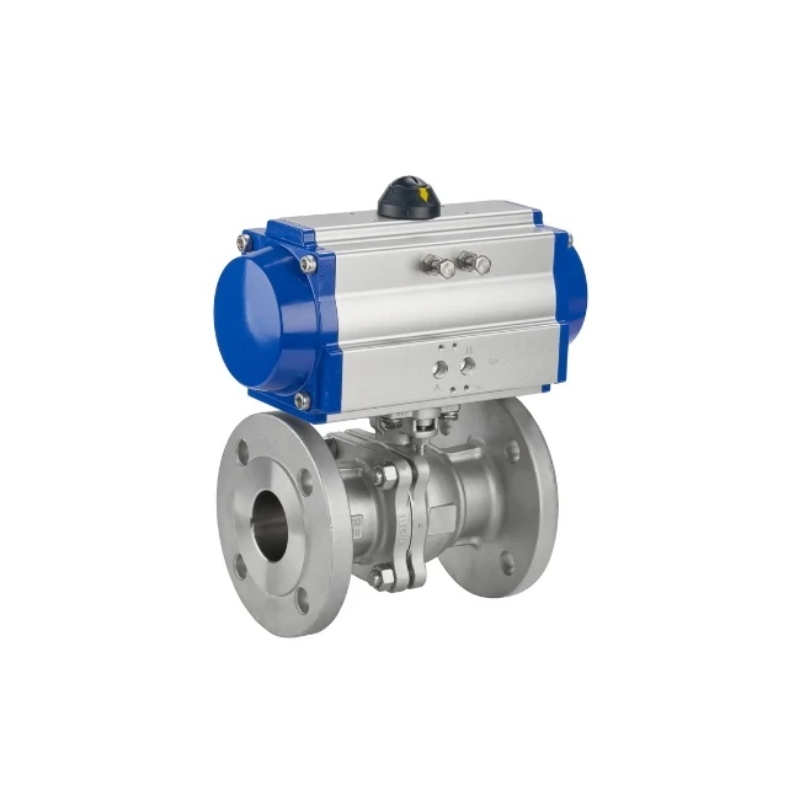
In modern industrial environments, the need for reliable, automated, and high-performance flow control continues to grow. As plants strive to improve efficiency, boost safety, and reduce manual operations, pneumatic actuated valves have become an essential component of advanced fluid-handling systems. Among these, the pneumatic flanged ball valve stands out as one of the most widely used and trusted solutions across industries such as oil and gas, petrochemicals, chemical processing, power generation, pharmaceuticals, water treatment, and more.
These valves combine two powerful engineering features: the tight-sealing, quarter-turn operation of a ball valve and the high-speed automation of a pneumatic actuator. When integrated with flanged end connections, the result is a durable, easy-to-install, and maintenance-friendly valve designed to handle demanding industrial processes. This combination of performance and practicality makes pneumatic flanged ball valves highly suitable for high-pressure systems, thick or viscous media, and applications where dependable isolation or rapid actuation is required.
This in-depth industry news report explores the working principle, structural design, features, applications, and growing market relevance of pneumatic flanged ball valves. It also examines how technological advancements, material innovation, and increasing global automation needs are driving widespread adoption of these valves across industrial sectors.
A pneumatic ball valve is an automated control valve that uses compressed air to operate a rotating ball element. At the core of the valve is a spherical disc—the “ball”—containing a through-hole called a bore. When compressed air enters the pneumatic actuator, it converts air pressure into mechanical torque. This torque rotates the ball 90 degrees:
Open Position:
The bore aligns with the pipeline, allowing fluid to pass through with minimal resistance.
Closed Position:
The ball rotates perpendicular to the flow path, blocking the passage and ensuring tight shut-off.
Because pneumatic actuators respond quickly to air pressure and require no electrical components in standard configurations, they are exceptionally reliable in hazardous or explosive environments. They also exhibit rapid response times, making them ideal for systems requiring fast open/close cycles, emergency shut-offs, or automated process control.
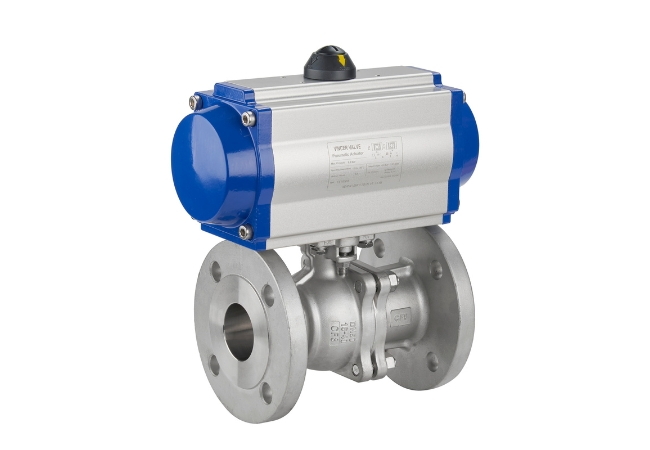
A pneumatic flanged ball valve integrates a pneumatic actuator with a ball valve body equipped with flanged ends. Flanges provide strong, secure, and leak-resistant connections between pipeline sections, allowing the valve to withstand higher pressures and mechanical stresses compared to threaded or socket-weld connections. This makes pneumatic flanged ball valves particularly suitable for:
- High-pressure systems
- Thick or abrasive fluids
- Critical process lines
- Industrial pipelines requiring easy maintenance
The combination of pneumatic actuation and flanged end connections results in a valve that is both robust and easy to install, remove, or replace—ensuring minimal downtime in demanding industrial environments.
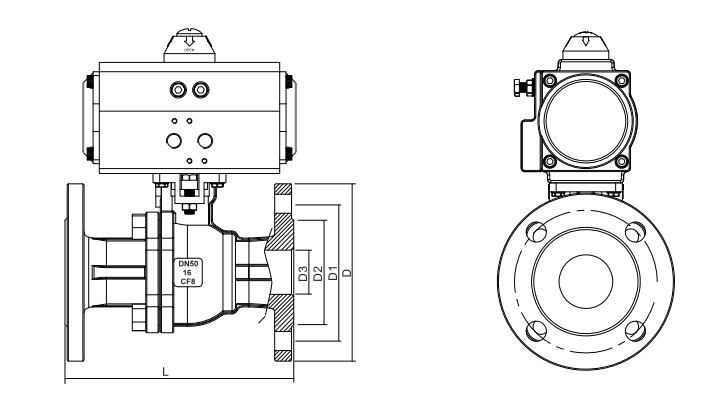
Pneumatic actuators deliver rapid opening and closing speeds, far faster than electric or manually operated valves. This responsiveness is essential in systems requiring immediate isolation to prevent equipment damage, contamination, or safety hazards.
Ball valves are known for their ability to achieve bubble-tight shut-off. Pneumatic actuation ensures the ball rotates fully and consistently, maintaining reliable sealing even under high pressure, high temperature, or corrosive media conditions.
Pneumatic flanged ball valves integrate seamlessly into automated control systems, allowing operators to manage flow remotely via:
- Distributed Control Systems (DCS)
- Programmable Logic Controllers (PLC)
- SCADA monitoring systems
This level of automation enhances system efficiency, reduces manual labor, and minimizes the risk of human error.
Because pneumatic actuators operate on compressed air rather than electricity, they are suitable for explosive or flammable environments such as chemical plants, oil refineries, and offshore platforms.
Engineered for durability, these valves offer long operational life due to:
- Strong flanged body connections
- Heat-resistant and corrosion-resistant materials
- Robust pneumatic actuation mechanisms
All these qualities contribute to reduced maintenance and downtime.
Typically manufactured from carbon steel, stainless steel, cast steel, or alloy steel, the valve body houses the ball and ensures structural integrity under pressure.
The ball is a precision-machined sphere with a through-hole. It rotates on a stem to open or close the flow path. For corrosive or abrasive media, balls can be:
- Chrome-plated
- Hard-coated (e.g., tungsten carbide)
- Stainless steel (304, 316, 316L)
Depending on the application, the sealing seats may be:
- Soft seats (PTFE, R-PTFE, PEEK) for chemical resistance and leak-tight performance
- Metal seats (Stellite, alloy steel) for high temperatures, steam, or abrasive fluids
Flanges provide:
- High structural strength
- Easy installation and removal
- Secure sealing via gaskets and bolts
- Compatibility with ANSI, DIN, JIS, and GB standards
The actuator converts compressed air into rotational torque. There are two common types:
Single-acting (spring return)
Uses air to open or close, with a spring to return the valve to a fail-safe position.
Double-acting
Uses air pressure for both opening and closing operations.
To enhance automation, pneumatic ball valves are often equipped with:
- Solenoid valves
- Limit switches
- Air filters and regulators
- Positioners
- Speed control devices
These components ensure accurate and reliable valve operation.
Pneumatic flanged ball valves are engineered to deliver complete shut-off, eliminating leakage and ensuring safe fluid isolation. This is vital in environments handling corrosive, toxic, or flammable media.
With pneumatic actuators, the ball can be positioned accurately for throttling or flow modulation. Paired with smart positioners, pneumatic ball valves can perform precise proportional control functions.
Flanged ends simplify installation by offering:
- Accurate pipeline alignment
- Reduced risk of leakage
- Quick replacement without welding
- Compatibility with standardized piping systems
These valves function reliably in:
- High-pressure systems
- High-temperature processes
- Cryogenic applications
- Corrosive chemical pipelines
- Steam distribution networks
Their flexibility makes them valuable in virtually every industrial sector.
The unobstructed flow path of ball valves ensures minimal pressure drop. This makes pneumatic flanged ball valves ideal for processes requiring high flow efficiency.
With fewer moving parts and strong construction, pneumatic flanged ball valves have low wear rates and require minimal service.
Pneumatic flanged ball valves are extensively used in:
- Crude oil pipelines
- Natural gas transmission
- Offshore platforms
- Storage tank systems
- Refining processes
Their explosion-proof actuation and robust sealing make them ideal for hazardous environments.
Used for handling acids, solvents, polymers, and corrosive media, these valves support:
- Batch processing
- Reaction control
- Distillation columns
- Chemical storage and transfer
Corrosion-resistant materials and automated control are essential in these systems.
In power plants, pneumatic flanged ball valves are used for:
- Steam lines
- Cooling water systems
- Fuel handling
- Condenser operations
Their fast operation supports emergency shutdown and load adjustments.
Municipal and industrial water treatment plants use these valves for:
- Filtration control
- Chemical dosing
- Pump station flow regulation
- Sludge handling
Flanged connections ensure long-term reliability in large-diameter pipelines.
Automated ball valves help regulate:
- Chilled water loops
- Heating systems
- Air-handling units
In sanitary applications, stainless steel pneumatic ball valves provide:
- Clean and hygienic flow control
- Easy sterilization
- Precision operation in sterile production lines
Modern pneumatic actuators now incorporate:
- Intelligent positioners
- Digital communication (HART, Profibus, Modbus)
- Remote diagnostics
- Auto-calibration features
This supports Industry 4.0 and smart plant management.
To enhance durability, manufacturers use:
- Hard chrome plating
- Tungsten carbide coating
- Electroless nickel plating (ENP)
- Stellite overlay
These treatments improve resistance to corrosion, abrasion, and high temperatures.
Newer seat options increase performance in severe service conditions, including:
- PEEK for high-temperature chemical resistance
- Metal-seated designs for steam, slurry, and abrasive fluids
Engineering improvements in actuator geometry have reduced air consumption, lowering operational costs and improving efficiency.
Safety innovations include:
- Fail-safe spring return designs
- Over-torque protection
- Integrated emergency shut-down (ESD) features
- Explosion-proof accessory enclosures
Manufacturing plants worldwide are investing in:
- Automated valves
- Remote monitoring
- PLC/DCS integration
Pneumatic flanged ball valves align perfectly with these goals.
Processes involving high-pressure fluids require valves that can withstand intense operating conditions. Flanged ball valves provide the necessary strength.
Chemical production, refining, and energy generation continue to expand—especially in Asia-Pacific, the Middle East, and Africa. This boosts demand for robust automated valves.
Valves with fast-response pneumatic actuators support safety standards such as SIL (Safety Integrity Level) compliance.
Compared with electric actuators, pneumatic systems often offer:
- Lower initial cost
- Faster actuation
- Better safety in explosive environments
This drives strong adoption in the oil and gas sector.
Pneumatic systems require high-quality air. Moisture or contaminants can cause actuator failure.
Compressed air systems require compressors, dryers, and piping networks, increasing system complexity.
For extremely high-temperature applications, metal-seated designs are necessary.
Periodic maintenance is required for:
- Seals
- Springs
- Air lines
Engineers must carefully choose:
- Stainless-steel grades
- Coatings
- Seat materials
Incorrect selection can lead to premature valve failure.
Pneumatic flanged ball valves have become essential components in automated industrial flow-control systems. Their combination of fast actuation, bubble-tight sealing, strong flanged connections, and reliable performance under high pressure and harsh environmental conditions makes them a preferred choice across industries including oil and gas, chemical processing, power generation, water treatment, and manufacturing.
As global demand for automation, safety, and energy efficiency continues to rise, pneumatic flanged ball valves will remain a key technology enabling safer, smarter, and more efficient industrial operations. Their sturdy design, advanced materials, and compatibility with digital control systems ensure long service life and adaptability to the evolving needs of modern engineering environments.